
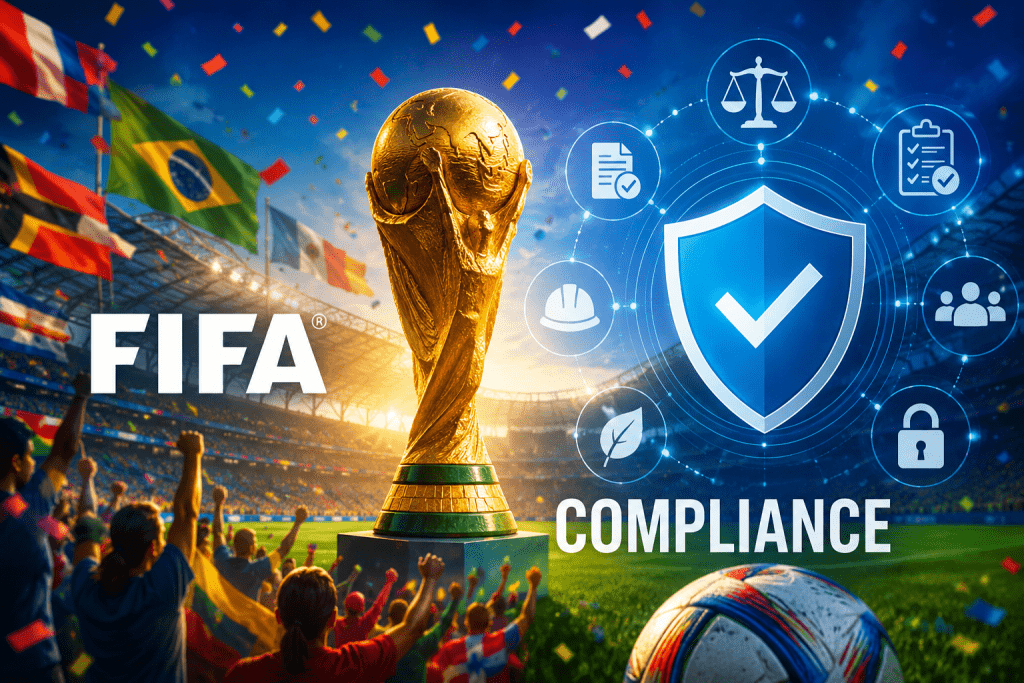
The FIFA World Cup is a great example of how an organisation, business or country must understand and manage the contractual obligations that its stakeholders can expect.
At first glance, the tournament is about football: the teams, the supporters, the stadiums, the celebrations and the unforgettable moments. Behind every match, however, is an enormous network of host authorities, venue operators, construction companies, airlines, hotels, caterers, security providers, technology businesses, broadcasters, medical teams, transport operators and thousands of workers and volunteers.
Every organisation in that network has a job to perform. More importantly, each organisation has contractual, legal and compliance requirements governing how that job must be performed.
Delivering a successful FIFA World Cup is therefore not just a sporting challenge. It is one of the clearest possible examples of large-scale compliance management, contractual governance and supply-chain control.
Contractual Obligations and Compliance Management
A contract connected to the FIFA World Cup is unlikely to state only what must be delivered. It will also establish how the product or service must be delivered, measured, evidenced and controlled.
Contractual obligations may include requirements relating to:
- Quality and service performance
- Occupational health and safety
- Environmental protection
- Information security and data privacy
- Business continuity
- Cybersecurity and incident reporting
- Ethical sourcing and modern slavery prevention
- Accessibility and equality
- Insurance and financial controls
- Competence, training and accreditation
- Record retention and audit rights
- Applicable laws, regulations and recognised standards
Some contracts may expressly require certification to an ISO standard. Others may require controls that closely align with ISO 9001, ISO 14001, ISO 45001, ISO/IEC 27001, ISO 22301 or another recognised management-system framework.
The important distinction is that ISO certification and contractual compliance are not always the same thing. An organisation may be contractually required to follow particular controls without being independently certified. Equally, holding a certificate does not remove the responsibility to fulfil the specific conditions of the contract.
A supplier must be able to demonstrate that its obligations have been understood, assigned, executed, checked and evidenced.
The Top 10 FIFA World Cup Compliance Considerations
1. Legal and Regulatory Compliance
Tournament-related organisations must identify the legislation, licences, permits, regulations and contractual rules that apply to their activities.
These can include employment law, health and safety legislation, fire regulations, environmental permits, food safety rules, building regulations, privacy law, transport requirements and cybersecurity obligations.
A well-maintained legal and contractual obligations register provides the foundation for this work. Compliance must also be reviewed when laws, operations or contractual requirements change.
2. Contractor and Supply-Chain Management
A major tournament relies on an extensive and often international supply chain. Contractors may provide construction, security, catering, transport, technology, broadcasting, cleaning and temporary labour.
Supplier approval must therefore go beyond price and availability. Organisations may need to evaluate competence, insurance, certification, environmental performance, information-security controls, safety history, financial stability and operational capacity.
Requirements should then flow into purchase orders, subcontractor agreements and service-level agreements.
3. Risk Assessment and Risk Management
Each organisation must understand what could prevent it from meeting its obligations.
Risks may include crowd incidents, cyberattacks, power outages, extreme weather, equipment failures, transport disruption, food contamination, construction delays, data breaches and supplier failure.
The assessment should consider the likelihood and potential effect of each risk, existing controls, additional actions, responsible owners and review dates.
Risk management cannot be a document created and then forgotten. It must influence decisions and day-to-day operations.
4. Health and Safety for Workers and Spectators
Health and safety responsibilities extend from stadium construction to the final spectator leaving the venue.
Controls may cover temporary structures, crowd movements, fire safety, emergency evacuation, workplace transport, manual handling, fatigue, heat stress, medical provision, food preparation and volunteer welfare.
ISO 45001 can provide a structured occupational health and safety management framework, but organisations must also satisfy the applicable laws and the specific safety terms in their contracts.
5. Environmental Sustainability and Performance
A global event can generate significant energy use, emissions, travel, water consumption, construction activity and waste.
Environmental compliance should therefore address waste management, pollution prevention, sustainable procurement, energy efficiency, water conservation, biodiversity, transport planning and emergency response.
ISO 14001 provides a framework for identifying environmental aspects, evaluating risks and opportunities, establishing objectives and measuring performance. The 2026 edition places renewed emphasis on connecting environmental management, organisational context and measurable business outcomes.
6. Emergency Preparedness and Business Continuity
Organisations must be ready for incidents that interrupt normal operations.
Plans may be needed for fire, severe weather, medical emergencies, crowd disorder, power loss, telecommunications failures, cyber incidents, transport disruption and the loss of a critical supplier.
Emergency plans should be exercised rather than merely documented. Responsibilities, communications, escalation routes, recovery priorities and alternative arrangements must be understood before the incident occurs.
7. Information Security and Cyber Resilience
Ticketing, accreditation, payment, broadcasting, travel, personal data and venue-access systems all depend on secure information.
Relevant controls may include access management, multifactor authentication, encryption, backups, vulnerability management, supplier assurance, monitoring, incident response and disaster recovery.
ISO/IEC 27001 for SMEs can also be valuable outside major events. A smaller supplier may handle commercially sensitive information or personal data that connects directly to a much larger customer’s systems and supply chain.
8. Quality Assurance for Infrastructure and Services
The spectator experience depends on thousands of activities being performed consistently.
Quality controls may cover construction inspections, equipment testing, calibration, catering, cleaning, transport punctuality, accessibility, customer service, complaint handling and corrective action.
ISO 9001 supports a process-based approach to understanding customer requirements, controlling delivery, monitoring performance and continually improving results.
9. Stakeholder Communication and Governance
Successful compliance requires clear accountability.
FIFA, host authorities, emergency services, venue operators, sponsors, broadcasters, suppliers, teams, communities and spectators may all have different expectations.
Organisations must define decision-making authority, reporting arrangements, escalation routes, document-control responsibilities and communication protocols. This is where effective Risk and Governance Support becomes essential.
10. Monitoring, Auditing and Continual Improvement
Compliance must be checked.
Monitoring may include inspections, performance indicators, supplier reviews, Internal Audit Services, management reviews, incident investigations and corrective actions.
Effective ISO Audit Support does more than prepare documents shortly before a certification visit. It helps an organisation determine whether its controls are being followed, whether evidence can be found and whether the management system works throughout the year.
From Football Tournament to Integrated Management System
The strongest approach is often to combine quality, environmental, health and safety, information security and business-continuity controls into one Integrated Management System.
An integrated system reduces duplicated policies and audits. It can create shared processes for risk management, document control, competence, supplier approval, incidents, corrective actions, objectives and management review.
That is important because an operational failure rarely fits neatly into one category. A power outage may be a quality problem, a safety risk, an information-security incident, an environmental issue and a contractual breach at the same time.
Compliance Makes the Spectacle Possible
Good compliance allows every spectator to enjoy the FIFA World Cup safely, securely and in a high-quality environment that considers spectators, participants, workers, organisers, referees and players.
It stretches from the person processing your booking to the person checking your ticket and showing you to your seat. It reaches from the person purchasing refreshments to the driver delivering them and the team preparing and serving them. It connects the security officer at the entrance, the security team in the stands and the officials protecting the field of play.
It also connects the airline, aircraft inspectors, pilots and cabin crew; the bus company planning the journey, the mechanics checking the vehicle and the driver transporting the players to the stadium.
Every step requires standards that must be implemented, followed, checked and, where necessary, independently audited.
Compliance Management for Every Organisation
The same principle applies whether your business supplies the FIFA World Cup, operates a printing company, manages a financial institution, manufactures products, provides professional services or delivers medical care.
Every business has legal, regulatory, contractual and customer requirements that it must understand and satisfy.
Compliance Managers Group helps businesses in the UK, Ireland, the Isle of Man, the United States, South Africa and internationally to build, implement, audit, certify, manage and maintain practical compliance systems.
Our approach is straightforward:
Build — Structured from day one.
Audit — Always audit-ready.
Certify — Certification secured.
Manage — Compliance covered.
We help take the stress out of compliance by creating systems that are easy to operate, easy to evidence and easy to improve. Our purpose is not to build theoretical paperwork. It is to develop management systems that reflect how your business actually works.
Whether you need an Outsourced Compliance Manager, a Fractional Quality Manager, ISO Audit Support, Management System Maintenance or an external management representative, Compliance Managers Group can provide practical support.
Have you searched for “an ISO consultant near me”? Your consultant does not necessarily need to sit in your office every day. We can operate as an extension of your team, providing the specialist resources you need without requiring you to manage every compliance activity in-house.
A free consultation or gap analysis can identify your compliance pain points and help establish a proportionate programme suited to your activities, size, risk profile and budget.
Compliance management, done for you.












Comments are closed